
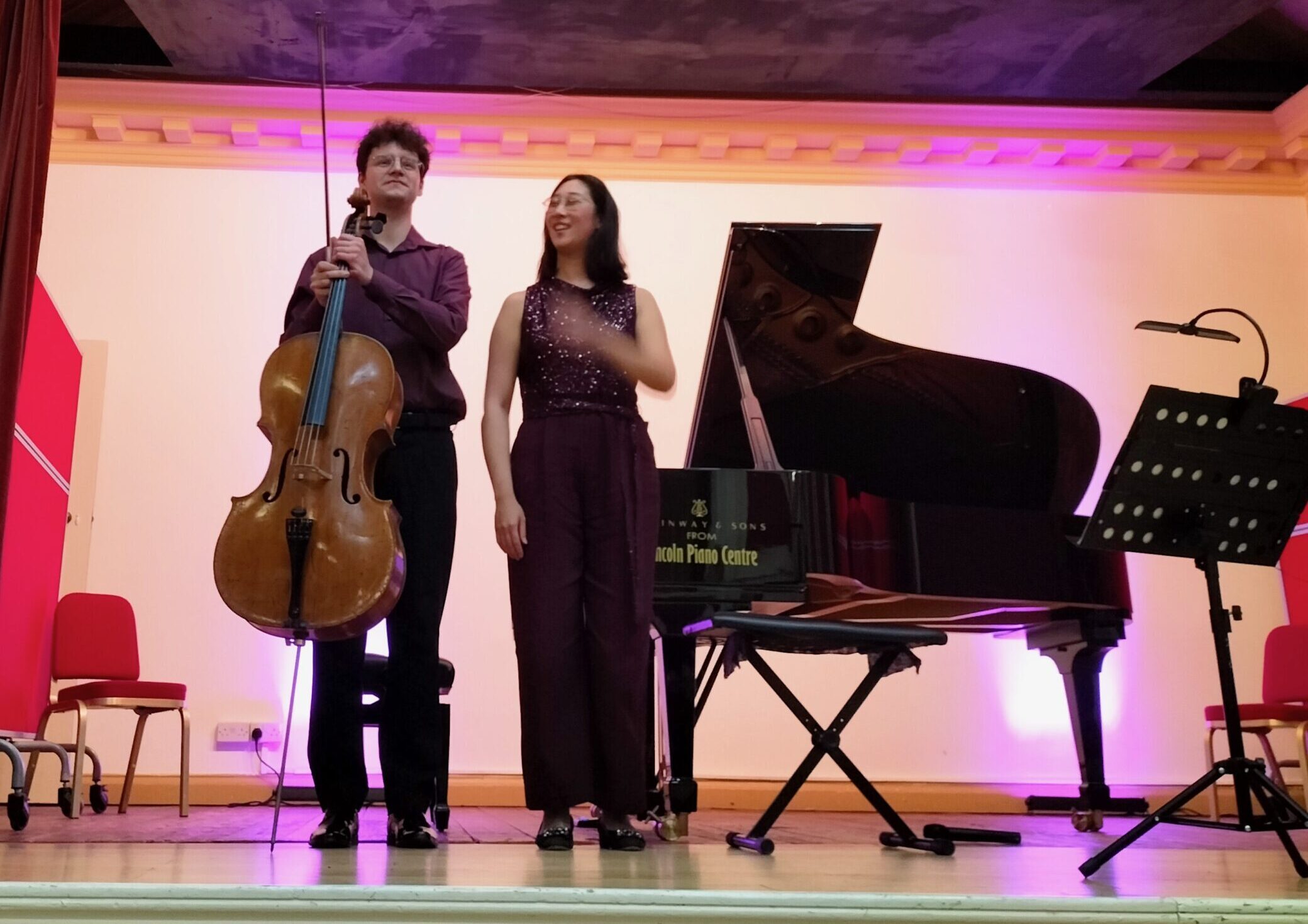
The first concert of the new year took place at the Cavendish Hall in front of a full hall, and showcased Kosta Popović, a young Montenegrin cellist accompanied by Valentina Wang, originally from Italy. Both performers were graduates of the Guildhall School of Music and Drama. Kosta was playing on an English cello dated 1780. The Concert was made possible by support from the Countess of Munster Musical Trust, who support young musicians in the early years of their professional careers.
As the concert progressed, Kosta introduced each of the pieces that were to be played, and the first piece heard was Variations in E♭ Major for Piano and Cello written by Beethoven. This was a dialogue in seven movements between the two instruments in the same key that the composer used for the Eroica Symphony. It enabled both performers to display their skills in quieter passages of music. This piece was followed by Silent Woods by Dvořák, which has seen numerous transcriptions for different instruments, but this is the original. It is a very lyrical piece which enabled the cello soloist to showcase his instrument, and we heard for the first time the enormous depth of tone of his instrument, especially when playing on the lower strings.
The first half of the concert concluded with the Sonata for Viola da Gamba in G minor by JS Bach. This is the third of three such Sonatas. The piece is in three movements and starts with a movement marked vivace, which was reminiscent of the Brandenburg Concerti; the middle movement, an adagio, allows both instruments to intertwine melodies, while the final movement, marked as allegro, was a brisk finale played with panache by our two performers.
After the interval, we first heard a Sonata for Cello and Piano in D minor by Debussy. This piece was written in three movements, and in its first performance in France, Debussy played the piano part. After a slow first movement, the music moves to a serenade, with a final fast movement. This work includes all sorts of instructions to the performers, especially the cellist, as to what techniques the composer is expecting.
The final piece of the evening was a Sonata for Cello and Piano in G minor by Chopin. Written in four movements, this piece was one that the composer constantly amended during his lifetime and was the final piece that he composed. He never was really happy with the first movement, and when he performed this work at the end of his life, he only performed the final two movements. It is a lengthy work and allows the cello especially to show its range. The final movement moves from G minor to the key of G major at its close.
Both performers are young and just beginning their professional careers but they both played with maturity and are extremely affable individuals. We look forward to seeing their names on the world music stage.