
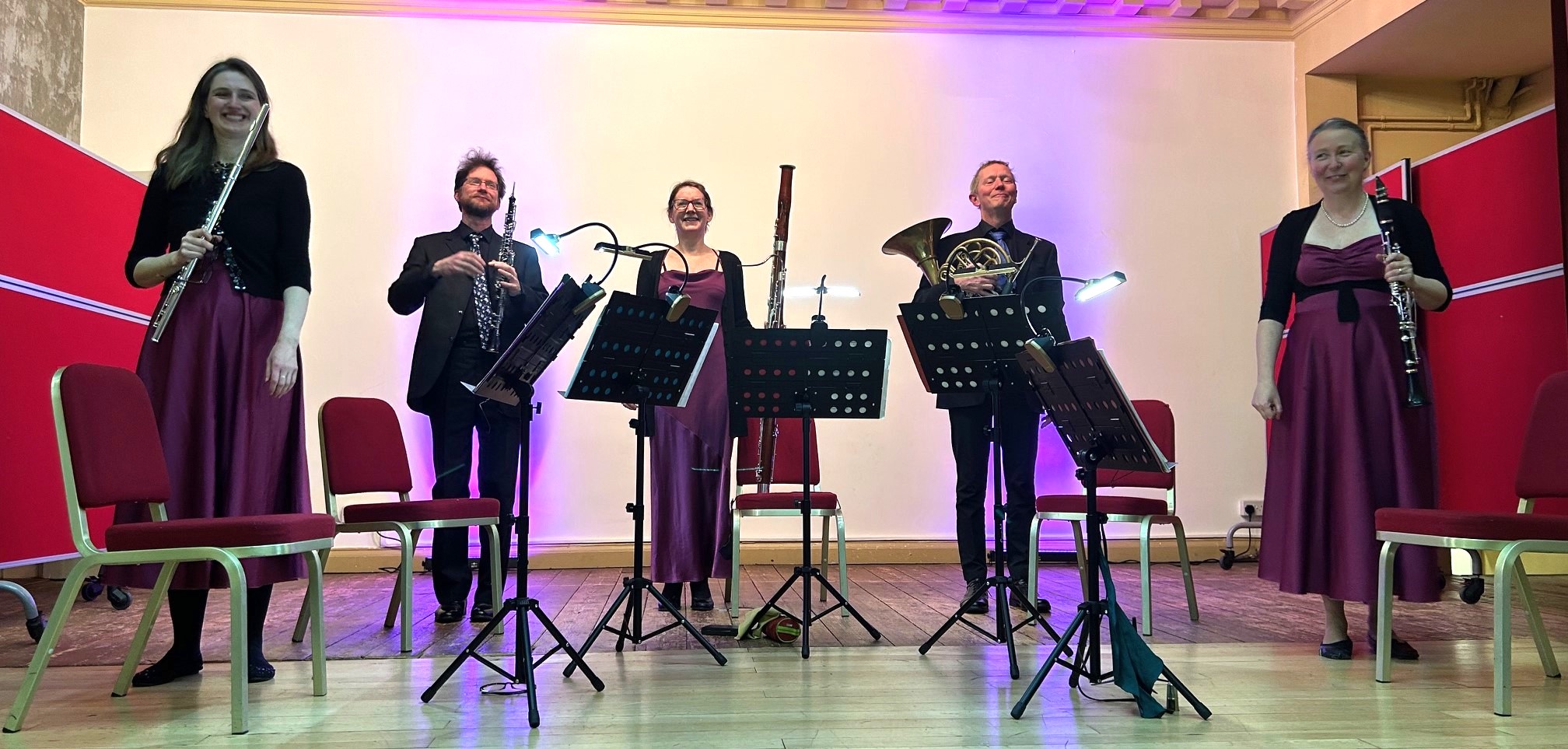
The Galliard Ensemble has been together now for 30 years, ever since its members studied together at the Royal Academy of Music. Just as with a first growth claret, their individual characteristics have melded together as they have matured to produce a superb blend of sound, with enormous breadth and depth – the very essence of ensemble playing. They clearly enjoy playing together now every bit as much as in their youth, and the precision of their playing held the Peak Music audience spellbound from the very start with the precision of the slow staccato opening chords of Rossini’s overture to the Italian Girl in Algiers.
The quintet took it in turns to introduce each piece with fascinating snippets and anecdotes – always much appreciated by the Peak Music audience. Mozart’s solemn and funereal Fantasie in F minor, for example, was written to be performed by a mechanical organ clock, on the hour every hour, in a Field Marshal’s mausoleum. This was the cutting edge of technical achievement in the eighteenth century, but sadly Mozart was disappointed by the result, declaring it sounded ‘tinny and an octave or two high.’
Three pieces from Ravel’s Tombeau de Couperin then followed. This work commemorated those of his friends killed in World War I, as well as being a homage to Couperin. In reaction to the excesses of nineteenth century German romantic music, Ravel and others looked back to the French baroque style for inspiration – much lighter and more dancelike than the German baroque of Bach and others. The first two movements were reflective and threnodic, with the third being more lively and even jaunty.
The first half concluded with Bozza’s Scherzo, which had been written as a test piece for bassoonists at the Paris Conservatoire. Though lyrical and fun, it is technically demanding and designed to demonstrate that the players had been practising their scales assiduously! The running scales with their rising and falling crescendos and diminuendos had a hypnotic wave-like quality.
After the interval, the ensemble performed the much-loved Holst Wind Quintet, clearly one of their signature pieces – played so much by them that the scores were decidedly tattered. This work was written in 1904, but disappeared in 1914 when Holst lent it to a flautist, not reappearing until 1978, when it was found in papers held at the Surrey History Centre.
The concert concluded with items more in the folk music genre. Percy Grainger’s Walking Tune was composed entirely in his head as he listened to the tramping of his feet in the Scottish Highlands, while his Lisbon was based on a folk tune he had tracked down to an old gentleman in a Lincolnshire Nursing Home. This chap became so overcome by emotion as he sang, that the nurse intervened half way through. Percy Grainger had to come back a year later to transcribe the rest – fortunately the man hadn’t died in the meantime!
The Galliard Ensemble have been friends of Paul Patterson ever since meeting him when they were students, and they commissioned Westerly Winds from him in 1999, a jolly romp through four West Country folk tunes – Scrumpy (Farmer) Giles, Widecombe Jan (from the eponymous Fair), Lazy Lawrence (with the tune from Linden Lea), and a final crazy finale The Looe Bar Lady, based on the rollicking Floral Dance forever associated with the late Terry Wogan, chopped up with the British Grenadiers and reprises of the first three tunes.
After such a bravura ending, the audience demanded an encore, and were duly rewarded with a more calming rendition of Norman Hallam’s Bossa Nova from his Dance Suite.
The Galliard Ensemble last visited the Peak Music Society in November almost exactly 10 years previously, when their programme shared many similarities – starting with Rossini’s overture, Holst’s Wind Quintet after the interval, and finishing with a piece by Patterson. The ensemble had not changed in the intervening time, with the exception of the horn, where Roger Montgomery stood in for Richard Bayliss. Back in 2008, Michael Oliver of Gramophone Magazine praised their playing thus, ‘Pure pleasure… this, in short, is wind quintet playing of great distinction.’ Nothing had changed!